Capabilities
Customization Options
Six separate decisions go into a pillow box specification: the material, the board weight, the printing method, the coating, the decoration and the internal structure. Each one constrains the others, which is why they are set out together rather than as a menu.
Where an option cannot be done on this format — and several cannot — that is stated here rather than discovered at proof stage.
Talk through a specification
Describe the product and we will propose a combination rather than send you a price list.
Materials
The first decision, and the one that constrains everything after it.
| Option | What it does | Constraint |
|---|---|---|
| Natural kraft | Brown through the sheet; absorbs ink; excellent for line art | Pale colors need an opaque white base |
| Bleached white kraft | Fiber texture with a lighter printing ground | Still softer detail than a coated sheet |
| Coated paperboard (C1S) | Sharp detail, accurate color, all finishes available | White inside unless a C2S board is used |
| Coated paperboard (C2S) | Printable on both faces, for a designed interior | Higher board cost and a second press pass |
| Uncoated white | Warm, paper-like; takes a pen and a deboss | Muted printed color; marks readily |
| E-flute corrugated | Roughly three times the crush resistance | Ribbing on large solids unless litho-laminated |
| Clear PET | Full product visibility | Almost no branding surface without a band |
| Dyed-through colored board | Colored at every cut and crease | Limited palette; lead time matters more |
Printing
Spot colors are mixed inks that reproduce identically between runs and reach shades process printing cannot. Process printing builds color from four inks and is right where a design has many colors. The choice is usually settled by how many colors the artwork has.
- Spot color, one to three inks, from a Pantone reference
- Full CMYK process for photography and detailed artwork
- CMYK plus up to two spot colors, where a brand color must stay exact
- Opaque white underbase, for printing over kraft or a dark ground
- Inside printing on a board coated both sides
- Variable data, for shade names, model numbers or guest names
The mechanics, including which colors CMYK genuinely cannot reach, are in our printing guide.
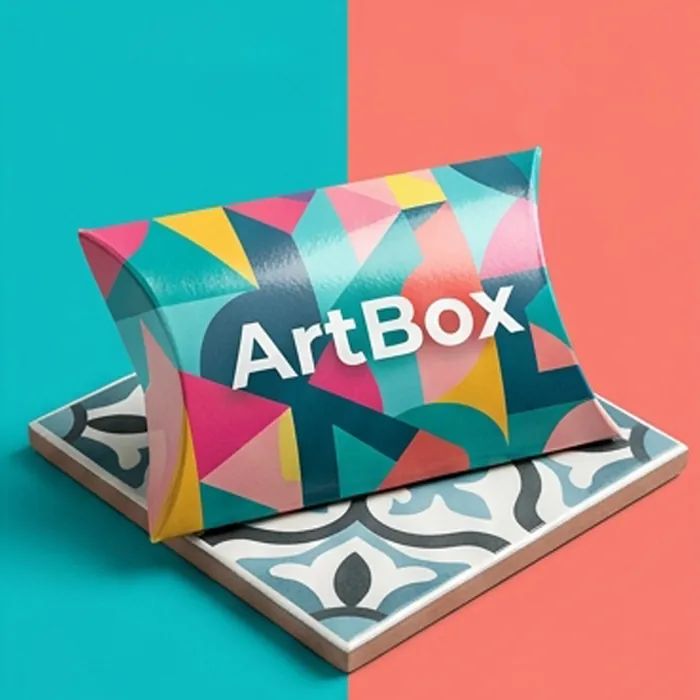
Coatings and decorative finishing
Coatings protect the print and change how the color reads. Decorative finishing adds something to the surface or to the shape of the board.
Coatings
- Uncoated — most recyclable, marks most readily
- Water-based varnish — scuff resistance without a plastic film
- Matte lamination — deepens color, kills glare, shows fingerprints on dark
- Gloss lamination — lifts saturation, most hard-wearing
- Soft-touch lamination — suede feel, marks quickly on open display
Decoration
- Foil stamping in gold, rose gold, silver, copper, matte white and holographic
- Embossing — raised from a custom brass die
- Debossing — pressed in; survives handling better than relief
- Combination foil and emboss, applied in a single pass
- Spot UV — gloss pattern over a matte laminate only
Which finish suits which ground, and what each one costs, is covered in our guide to decorative finishes.
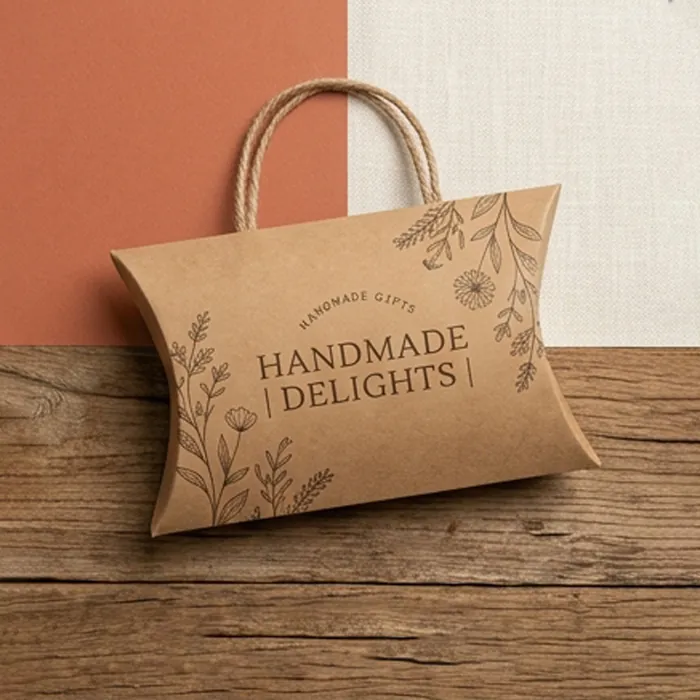
Structure and internal fittings
Structural features change the die, not the print, and all of them have to be designed in from the start. The curved tucks are the working part of a pillow box and nothing else may enter them.
- Die-cut windows in any shape, filmed or open
- Carry handles — die-cut with reinforcement, ribbon loops, or riveted
- Punched slots for ribbon, and reinforced hang holes for peg display
- Standing bases, cut differently from a flat-lying tuck
- Sealed postal closures with a designed address panel
- Die-cut trays, retaining cards, dividers, cradles and printed inserts
About customization
Can I combine several of these on one box?
Usually, yes. A kraft board with a window, a ribbon and a debossed mark is an ordinary specification. What we flag is a combination that weakens the pack — a large aperture on a panel that also carries a handle, for instance.
Which options carry a one-off tooling cost?
The cutting die, and any foil or emboss dies. All are charged once and stored, so a reorder of the same design carries no further tooling charge.
What cannot be done on a pillow box?
Anything that sits on a crease — foil and heavy embossing both crack there. Windows and handles cannot enter the curved tuck zones. And past a certain size and weight the format itself stops working, at which point we would recommend a different structure.
Do I have to decide all of this before quoting?
No. Tell us the product, its filled weight and how it reaches the customer, and we will propose a specification. Every option here can be added or removed before you commit.
How much does each option add?
It depends on quantity, because most of these are fixed costs spread across the run. We quote them itemized so you can see what each one is contributing rather than a single figure.
Can you match my existing packaging?
Send a physical sample. Matching to an object is far more reliable than matching to a photograph, and we will tell you honestly which parts of it we can reproduce and which we cannot.
Next step
Combine what your product actually needs
Send the product, the quantity and the date you need it on a shelf. We come back with a written quote, a specification and an honest view of anything in the brief that will not work.