Finishing
Decorative Finishes Explained
Decorative finishing is where packaging budgets go furthest and also where they are most often wasted. These are the four processes that matter on a pillow box, what each one actually does, and the constraints the format imposes on all of them.
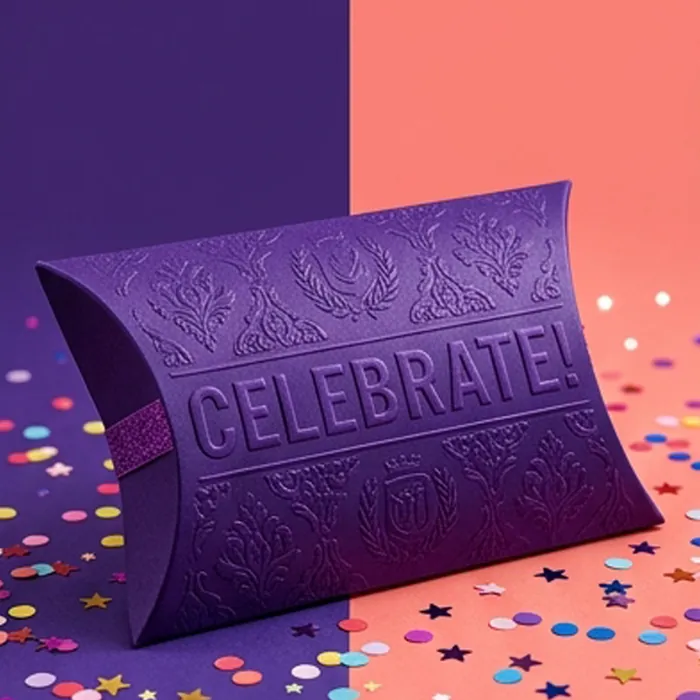
The four processes
Foil stamping
- A reflective film applied under heat and pressure
- The brightest effect available; requires a die
- Priced by area covered and die size
- Cracks if it sits on a crease
Emboss and deboss
- Shape pressed into or raised out of the board
- No ink involved; a brass die does the work
- Survives handling better than any surface effect
- Cannot cross a crease line
Spot UV
- A gloss varnish applied to selected areas
- Reads as pattern that appears at an angle
- Needs a matte laminate underneath to contrast against
- Cheapest of the three for large areas
Restraint outperforms scale here
The single most common finishing mistake is buying too much of it. A large foil panel costs several times a small one, is prone to pinholing, and reads as less expensive rather than more — because the thing that signals value is precision, not coverage.
A small, sharply executed foil monogram on a well-chosen board does more for a pack than a foiled panel at three times the price. The same applies to embossing: one confident mark beats an all-over pattern on almost every brief we see.
What the pillow box format rules out
- Any finishing that sits on or crosses a crease line will crack
- Deep relief near the curved tuck weakens the closure
- Very fine detail below about 0.4 mm collapses when embossed
- Foil hairlines below about 0.3 mm are a risk on any board
- The reverse of an emboss is visible, so a printed interior will show it
Foil colors and the grounds they suit
| Foil | Reads as | Best on |
|---|---|---|
| Bright gold | Celebratory, traditional | Black, navy, burgundy, deep green |
| Antique gold | Warm, restrained, heritage | Kraft, olive, plum |
| Rose gold | Soft, contemporary, tonal | Blush, ivory, pale gray |
| Copper | Artisanal, warm | Kraft, forest green, terracotta |
| Bright silver | Precise, modern, technical | Black, white, cobalt |
| Matte white | Clean, high contrast | Bright and mid-tone colors |
Tooling costs are one-off
Foil and emboss both need a brass die cut to your artwork. That is a fixed cost paid once, and we store the die, so a repeat order carries no further tooling charge.
It means finishing looks expensive on a first small run and reasonable on a program that repeats. If you expect to reorder, ask us to show the cost across the whole program rather than the first order alone — the two figures are very different. The tooling detail is on our embossing page.
Questions this raises
What is the difference between embossing and foil stamping?
Foil applies a metallic film to a flat surface. Embossing changes the shape of the board with no color added. Combined in one pass they give a raised metallic mark, which is the most expensive of the three.
Is the die reusable?
Yes, and we store it. As long as the artwork is unchanged, a repeat order carries no new tooling charge.
Can I foil the whole box?
Technically, but the cost scales with area and large solid foil is prone to pinholing. For an all-over metallic a metallized board is both better and usually cheaper.
Why is my spot UV barely visible?
It is almost certainly over a gloss laminate. The effect depends on contrast with a matte surface; over gloss there is nothing for it to contrast against.
Can finishing sit across a fold?
No. Foil cracks, and embossing on a crease weakens the board and distorts the fold. We mark the crease zones on every dieline so artwork can be planned around them.