By Feature
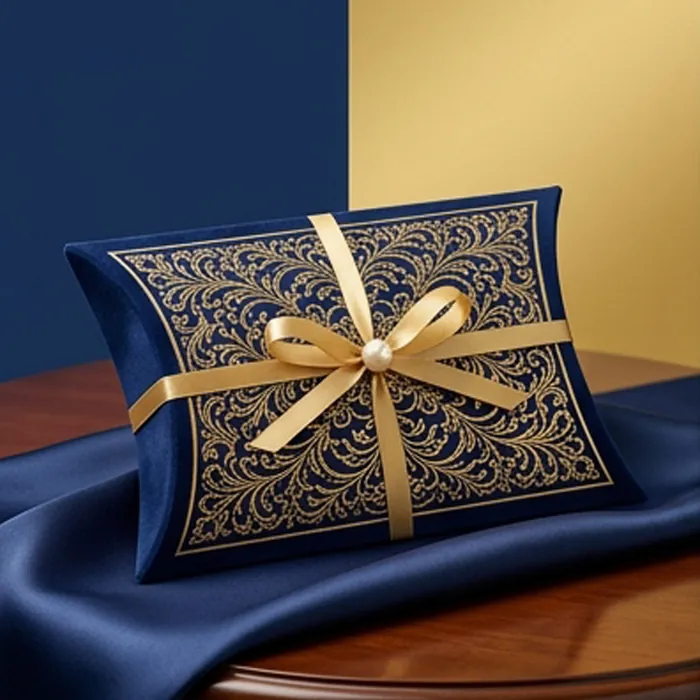
Embossed Pillow Boxes
Embossing pushes the board up from behind; debossing presses it down from the front. Both use a brass die cut to your artwork, and both give you something no amount of printing can: a mark with physical depth that catches light and changes as the box turns in someone's hand.
It is the most tactile decoration available on a pillow box, and on small formats it is often more effective than color. A debossed monogram on plain board says more about a brand than a printed one at three times the size.
- Custom brass dies cut from your vector artwork
- Blind emboss, blind deboss, or foil and emboss combined
- Single-level or multi-level sculpted dies for depth
- Works on kraft, coated white, black and colored board
- Registered to printed artwork, or used entirely on its own
Get a quote for embossed pillow boxes
Tell us the product, the size and roughly how many. We reply with a written quote and a specification.
Specification at a glance
| Tooling | Custom milled brass dies, single-level or sculpted |
|---|---|
| Techniques | Blind emboss, blind deboss, foil emboss, register emboss |
| Substrates | Kraft, coated white, dyed-through black, colored board |
| Minimum detail | Approx. 0.4 mm line weight; larger on uncoated stock |
| Artwork | Vector paths required (AI, EPS, PDF) |
What happens next
-
We read the brief
And come back with questions rather than assumptions if something is missing.
-
You get a written quote
With the specification stated — board, printing, finishing and any tooling.
-
We draw the dieline
Cut to your product, with the usable print area and crease zones marked.
-
Sample, then produce
A physical sample in the final board before a full run, where it is worth it.
Emboss, deboss, or both
Emboss (raised)
- Artwork stands proud of the surface
- Catches light on the raised edge
- Leaves a corresponding recess on the reverse
- Best on a panel where the inside is not seen
Deboss (recessed)
- Artwork is pressed into the board
- Reads as a shadow rather than a highlight
- Survives stacking and handling better
- The safer choice on a box that gets packed tight
Foil emboss
- Foil and relief applied in one pass
- A single die does both, so registration is exact
- The most expensive and the most striking
- Standard on luxury jewelry and beauty packs
What the artwork needs to be
Brass dies are cut from vector paths, so the artwork has to be vector — a logo saved as a JPEG cannot be tooled. Fine detail is the other constraint: hairlines below roughly 0.4 mm tend to collapse because the board simply will not hold that shape.
Type embosses well down to about 8 point on a coated board and needs to be larger on kraft, where the open fiber softens the edge. If your mark has very fine serifs or thin rules, we will usually suggest simplifying the version used for the die rather than cutting something that will disappoint on press.
How an embossed job actually runs
-
Artwork review
We check the vector paths for detail that will not survive tooling and mark up anything that needs adjusting before the die is cut.
-
Die manufacture
A brass die is milled to your artwork. This is a one-off tooling cost, and the die is kept for repeat orders so you only pay it once.
-
Print
Any printed elements run first, so the relief can be registered to them.
-
Emboss or foil pass
The sheet passes through heated tooling under pressure. Depth and pressure are set against a proof, not assumed.
-
Die-cut and crease
The pillow box outline is cut and the end curves scored. The emboss position is set to clear the crease lines.
Practical constraints worth knowing
- Relief cannot sit on or across a crease line — it will crack
- Very deep embossing on a light board can split the surface fiber
- Uncoated and kraft stocks give a softer, less crisp edge than coated board
- The reverse of an emboss is visible; on a C2S printed interior it will show
- Tooling cost is fixed, so the effect gets cheaper per box as quantity rises
Embossed Pillow Boxes: common questions
Answers to what customers most often ask before ordering this specification.
What is the difference between embossing and foil stamping?
Foil stamping applies a colored metallic film to the surface with heat and pressure, leaving the board flat. Embossing changes the shape of the board itself with no color added. Combining them in one pass gives you a raised metallic mark, which is the most expensive of the three.
Can you emboss a photograph or a gradient?
No. Embossing works from a cut brass die, so it reproduces shapes and outlines, not tonal images. A multi-level sculpted die can suggest depth and modelling, but it is still a carved form, not a photograph.
Is the die reusable for future orders?
Yes, and we store it. As long as the artwork does not change, a repeat order carries no new tooling charge.
Which board takes an emboss best?
A slightly softer, thicker uncoated or lightly coated board holds relief better than a hard, thin coated sheet. Kraft embosses beautifully but with a softer edge. We will recommend a stock against your specific artwork.
Can I emboss the whole box in a pattern?
An all-over pattern is possible and looks striking, but the die is larger and therefore more expensive, and the pattern has to be planned around the crease lines. It is worth doing on a hero product rather than across a full range.
Does embossing weaken the box?
Not meaningfully, provided the relief is placed away from crease lines and the depth is set to the board. Deep relief on a light stock is where problems arise, and that is a specification decision we make with you.
How long does a brass die take to make?
It is a discrete step ahead of production rather than something that happens on press, so it adds time to a first order and none to a reorder. We give you the date with the quote rather than a general lead time.
Can embossing be added to boxes I have already ordered?
Not to finished boxes — the impression has to be made before the blank is die-cut and folded. It has to be planned into the run, which is why we raise finishing at quote stage rather than after a proof.
How deep can the relief go?
It depends on the board. A thicker, softer sheet holds more depth; a thin coated board splits at the surface if pushed. We set the depth against a physical test rather than to a number, and you can see it on a sample.
Is registered embossing over print reliable at this size?
It is achievable and it has tolerances. On a small pack, artwork that requires the relief to land exactly inside a printed outline should allow a little visual forgiveness, or use a blind emboss placed clear of the print.
Related
Others that suit the same brief
Chosen because they solve a nearby problem — a different material, a different scale, or the same product with one structural change.
Black Pillow Boxes
Deep matte black with foil or spot gloss — the shortest route to a premium read.
View options
Gold Pillow Boxes
Real metallic foil, metallic board, or printed gold — three different things.
View options
Jewelry Pillow Boxes
Presentation packaging at a fraction of a rigid jewelry box cost.
View options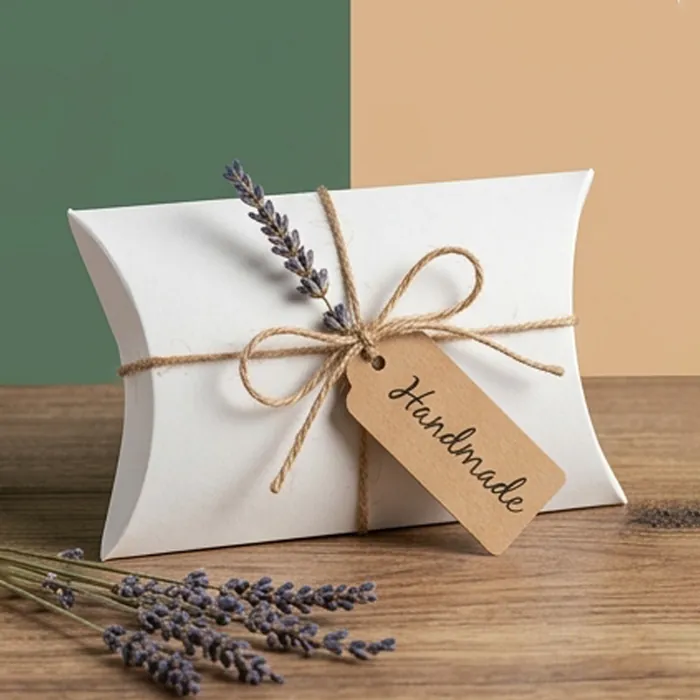
White Pillow Boxes
A clean white face — plain for minimal brands, or the best base for color.
View options
Cardboard Pillow Boxes
Coated paperboard with a white printing face — the stock for full-color artwork.
View optionsNext step
Ready to specify embossed pillow boxes?
Send the product, the quantity and the date you need it on a shelf. We come back with a written quote, a specification and an honest view of anything in the brief that will not work.