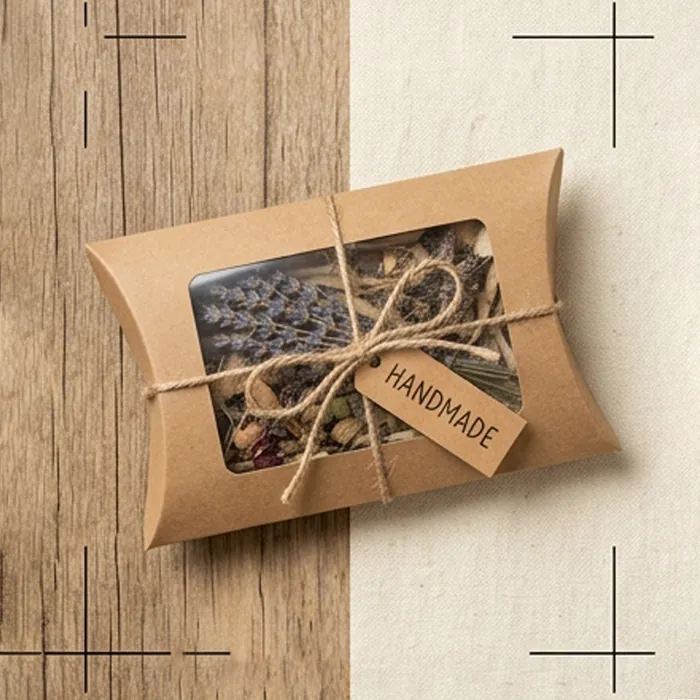
By Feature
Pillow Boxes with a Die-Cut Window
A window is the compromise between a printed box, which brands well but hides the product, and a clear box, which shows everything and brands poorly. Cut an aperture in the flat face and you keep the printed surface around it while giving the customer a defined view of what they are buying.
The aperture shape is entirely yours — a circle, an arch, a slot, the outline of your logo. It is die-cut, so a custom shape costs the same as a rectangle once the die is made. What matters more is where it sits, because the curved ends and crease zones of a pillow box are areas the window cannot cross.
- Any aperture shape, cut from a custom die
- Backed with clear PET film, or left as an open cut-out
- Frosted and tinted films available
- Aperture positioned clear of the crease and tuck zones
- Film-free option for a fully paper-based specification
Get a quote for pillow boxes with window
Tell us the product, the size and roughly how many. We reply with a written quote and a specification.
Specification at a glance
| Aperture | Any custom shape, cut from a bespoke die |
|---|---|
| Film | Clear PET, frosted PET, tinted; or none |
| Placement | Within the flat panel, clear of crease and tuck zones |
| Board | Any of our kraft, coated or colored stocks |
| Minimum order | Quoted per specification |
What happens next
-
We read the brief
And come back with questions rather than assumptions if something is missing.
-
You get a written quote
With the specification stated — board, printing, finishing and any tooling.
-
We draw the dieline
Cut to your product, with the usable print area and crease zones marked.
-
Sample, then produce
A physical sample in the final board before a full run, where it is worth it.
Where a window can and cannot go
The flat central panel is the usable area. The curved ends fold, and a window that reaches into the fold will crease the film and tear the board. There is also a margin around the crease lines where the board needs to stay intact to hold the structure.
In practice that leaves a generous but defined zone, and we mark it on the dieline before you design into it. The most common revision we make to customer artwork is pulling a window in from the edges by a few millimeters — worth building in from the start rather than discovering at proof stage.
Filmed or open
Filmed window
- Clear PET bonded behind the aperture
- Protects the contents from dust and handling
- Necessary for loose or fine products
- Reduces the pack's paper recyclability
Open die-cut
- No film at all — just a shaped hole
- Keeps the pack fully paper-based
- Contents can be touched, which may be a feature or a fault
- Best where the product is wrapped or solid
Getting a window to actually help you sell
A window is a merchandising decision, not a decoration. These are the things that make the difference:
- Show the most attractive part of the product, not the largest
- Size the aperture so the product fills it — a window with a gap looks empty
- Keep the shape simple; very intricate dies cut cleanly but read as busy
- Consider a printed insert behind the product to give the view a background
- Check what the window shows when the product settles, not when it is placed
Film choices
Clear PET is the standard: optically clean, stable, and it does not yellow. Frosted film diffuses the view, which suits products where you want a suggestion rather than full disclosure. Tinted films exist and are occasionally right for a seasonal range, though they distort the color of whatever is behind them.
Film thickness matters less than adhesion. A film that lifts at the corner after a few weeks in a warm store is the most common window failure, and it comes from the bonding rather than the material.
- Clear PET — the default, optically neutral
- Frosted PET — softens the view, hides minor product variation
- Tinted film — for seasonal or thematic ranges
- No film — the paper-based route where contents allow

Pillow Boxes with Window: common questions
Answers to what customers most often ask before ordering this specification.
Can the window be any shape?
Yes. The die is cut to your outline, so a circle, an arch, a leaf or your logo silhouette all cost the same once the tooling is made. Very fine internal detail is the only real constraint.
How big can the window be?
Large, but it has to stay within the flat panel and clear of the crease zones. We mark the usable area on the dieline. A window that takes most of the face also weakens the board, so there is a structural limit as well as a geometric one.
Is the film glued or is it part of the board?
It is a separate film patch bonded behind the aperture after die-cutting. The bond quality is what determines whether it stays flat, so it is worth specifying properly rather than accepting a default.
Will a window make the box weaker?
Any aperture removes material and reduces stiffness. On a small to medium window in a correctly weighted board it is not noticeable; on a very large aperture we would specify a heavier stock to compensate.
Can I have a window in a kraft box?
Yes, and it is a common combination — the contrast between the brown board and a clear view of the product works well for soap, food and bath products. See our kraft board specification for the stock itself.
What if I want full visibility rather than a window?
Then a fully transparent pack is the better answer. Our clear PET pillow boxes cover that route, including how to brand a transparent box.
Does the film window yellow over time?
PET does not, under normal conditions. Older PVC film can develop a faint yellow cast with age and UV exposure, which is one reason we specify PET as standard.
Can the window be positioned off-center?
Yes, anywhere within the flat panel that clears the crease zones. An off-center aperture can work well where the product sits to one side, and we will show the usable area on the dieline.
Will the window collect dust in a shop?
The outside face does, like any surface. A film window keeps dust off the product, which is often the main reason to specify one over an open aperture in a retail environment.
Can I have more than one window on a box?
You can, if each stays within the flat panel and the board retains enough stiffness. Two apertures on a small pack usually take out more strength than the design gains.
Related
Others that suit the same brief
Chosen because they solve a nearby problem — a different material, a different scale, or the same product with one structural change.
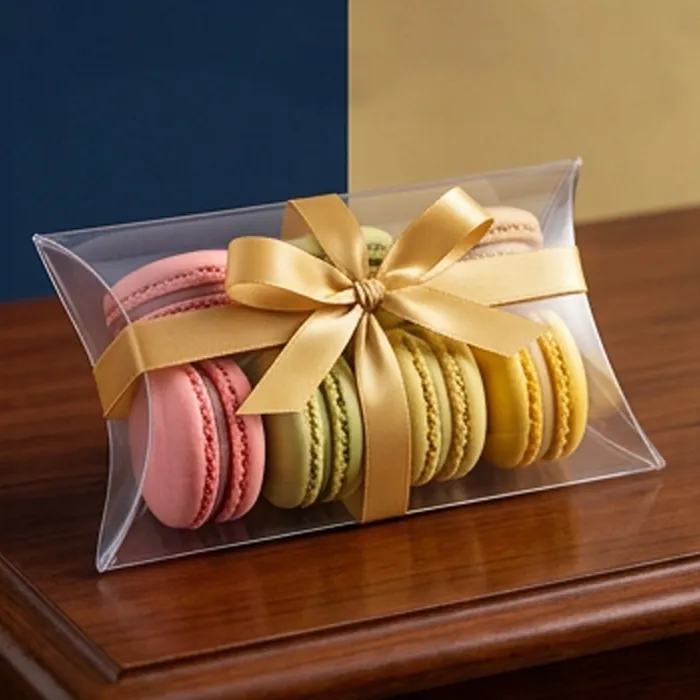
Clear Pillow Boxes
Transparent PET or PVC, for products that sell themselves on sight.
View options
Kraft Pillow Boxes
Natural brown kraft board with a visible fiber texture, printed one or two colors.
View options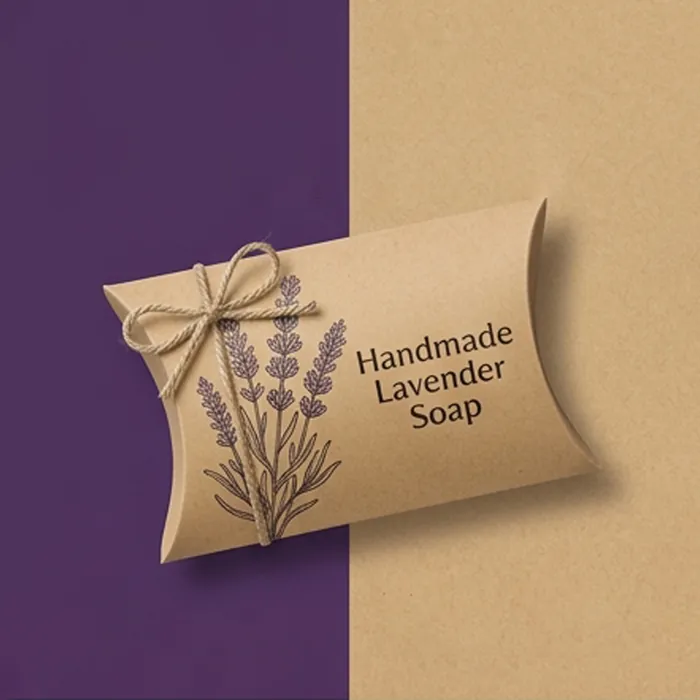
Soap Pillow Boxes
Cut to the bar, with apertures that let the scent through.
View options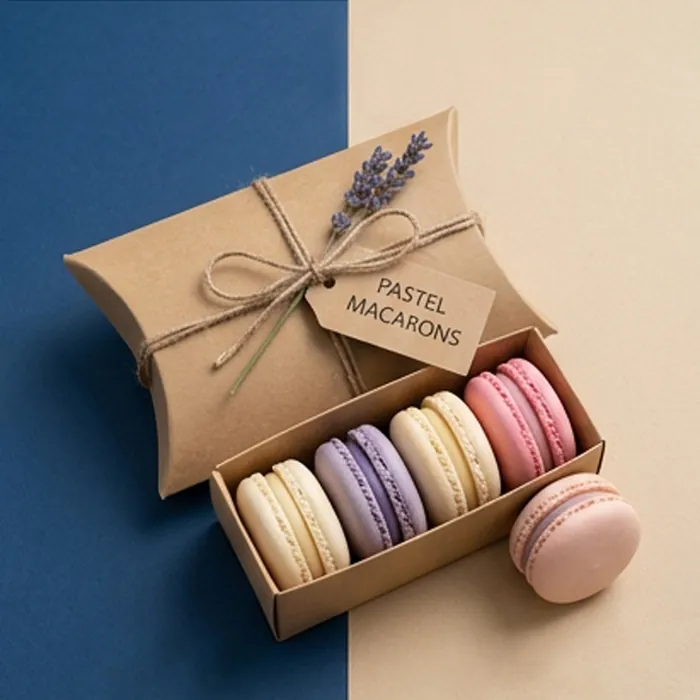
Macaron Pillow Boxes
Fitted trays for 3, 6 and 12 — the shell and foot are what you are protecting.
View options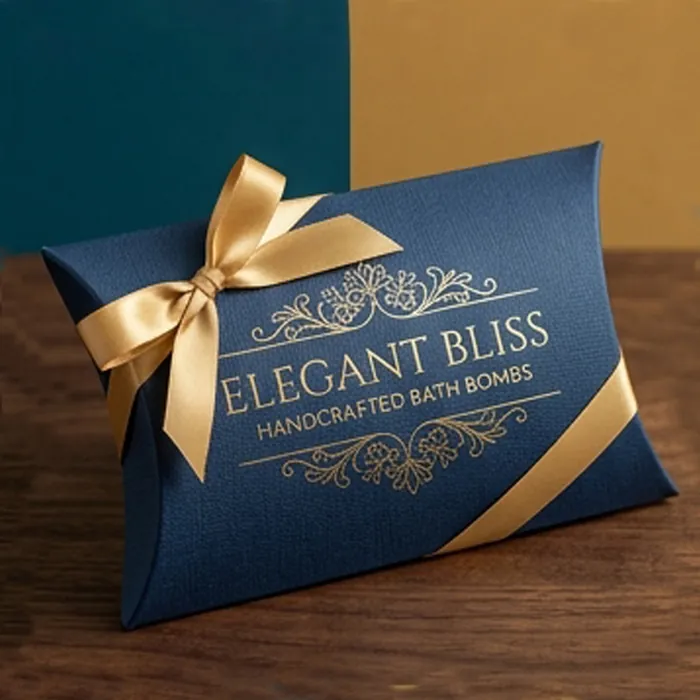
Bath Bomb Pillow Boxes
Moisture-aware packaging for a product that reacts to humidity.
View optionsNext step
Ready to specify pillow boxes with window?
Send the product, the quantity and the date you need it on a shelf. We come back with a written quote, a specification and an honest view of anything in the brief that will not work.