
By Material
Corrugated Pillow Boxes
Most pillow boxes are made from solid board, which is fine on a shelf and fine inside an outer carton. It is not fine on its own in a courier network. A corrugated pillow box puts a fluted layer between two liners, and that flute is what absorbs a knock instead of passing it to the product.
We build these in E-flute for most retail work and F-flute where the print surface needs to stay smooth. Both fold to the same familiar pillow shape; they just do it with roughly three times the crush resistance of a paperboard equivalent.
- E-flute and F-flute construction
- Kraft or white liner, printed direct or litho-laminated
- Sized to the product so there is no rattle inside
- Suitable for shipping without a secondary outer
- Optional internal pad or insert for fragile items
Get a quote for corrugated pillow boxes
Tell us the product, the size and roughly how many. We reply with a written quote and a specification.
Specification at a glance
| Construction | E-flute or F-flute corrugated |
|---|---|
| Liners | Natural kraft or white |
| Printing | Direct flexo or litho-laminated offset |
| Finishing | Uncoated, matte or gloss laminated face |
| Add-ons | Internal pads, cradles and die-cut retainers |
| Minimum order | Quoted per specification |
What happens next
-
We read the brief
And come back with questions rather than assumptions if something is missing.
-
You get a written quote
With the specification stated — board, printing, finishing and any tooling.
-
We draw the dieline
Cut to your product, with the usable print area and crease zones marked.
-
Sample, then produce
A physical sample in the final board before a full run, where it is worth it.
Flute grades and what they are for
Flute height decides how much protection you get and how well the surface prints. On a pillow box only the fine flutes are practical — anything taller will not take the end curve.
| Flute | Approx. thickness | Best for |
|---|---|---|
| F-flute | ~0.8 mm | Retail packs where print quality is the priority |
| E-flute | ~1.5 mm | The general-purpose choice: protection plus a printable face |
| B-flute | ~3 mm | Only on large formats; the curve gets stiff and cracks |
Printing onto a fluted sheet
There are two routes. Direct printing puts the ink straight onto the liner, which is economical and perfectly good for logos, line art and one or two colors. It also risks washboarding — a faint ribbing where the ink follows the flute underneath — on large solid areas.
Litho lamination prints your artwork on a separate sheet and bonds it to the corrugated board. The result is indistinguishable from a coated carton and takes photography without ribbing. It costs more and adds a step to the schedule, so we use it where the artwork genuinely needs it.
When to specify corrugated over solid board
- The item weighs enough to bow a paperboard face
- The pack ships direct to a customer without an outer carton
- The contents are brittle — glass, ceramic, a filled vial
- You want visible flute at the edge as a deliberate design cue
- The box has to survive being restocked and handled repeatedly
Inserts and internal support
A pillow box holds its contents by tension, which works well for something soft and less well for something that can slide. Where an item needs to stay put we add a simple corrugated pad, a folded cradle or a die-cut retainer inside the pack.
These are quoted with the box rather than bought separately, because the insert dimensions depend on the finished internal size after the flute thickness is accounted for — which is not the same as the flat dimension you started from.
- Flat pad to stop movement in the depth axis
- Folded cradle for cylindrical items such as candles
- Die-cut retainer for a single product held at the center
- Tissue or shred, where presentation matters more than restraint

Corrugated Pillow Boxes: common questions
Answers to what customers most often ask before ordering this specification.
Can a corrugated pillow box be posted on its own?
For most non-fragile retail products, yes — that is the main reason brands choose it. Add a shipping label area to the design and check the flat panel is large enough to carry it, which we will look at when we proof the dieline.
Does corrugated print as well as coated board?
Direct printing is good for one or two colors and line work but can show faint ribbing across large solids. Litho lamination removes that entirely and matches a coated carton, at a higher price.
Why not B-flute for extra protection?
B-flute is roughly twice the thickness of E-flute and simply will not take the tight end curve a pillow box needs without cracking the liner. On a large format it is occasionally workable, but E-flute is almost always the better engineering answer here.
Is corrugated recyclable?
Corrugated board is one of the most widely recovered packaging materials in the markets we serve. Adding a plastic laminate or a PET window reduces that, so if end-of-life is a priority, tell us and we will specify accordingly.
Can I have a window in a corrugated pillow box?
Yes, though the cut edge shows the flute, which some brands like and some do not. We can show you both on a sample before you commit.
How much heavier is the finished pack?
Noticeably — roughly two to three times the weight of an equivalent paperboard box. If you ship at a rated weight band, that is worth checking against your carrier tariff before you switch.
How much bigger is a corrugated box than a solid board one?
The flute adds roughly 1.5 mm per wall on E-flute, so the finished pack is about 3 mm larger in each direction than the same internal size in solid board. If the box has to fit a fixture or a rate band, that difference is worth checking before you approve the dieline.
Can corrugated pillow boxes be stored flat for long periods?
Yes, and better than solid board in one respect: the flute gives the blank more stiffness so it resists bowing on a pallet. Keep it dry — a fluted board that takes up moisture loses crush resistance quickly.
Is the flute direction important?
It is. Running the flutes across the curved tuck rather than along it makes the fold cleaner and the closure more reliable. We set it on the dieline; it is not something you need to specify, but it is worth knowing why the blank is oriented as it is.
Does corrugated cost more than solid board?
Per box, usually yes, because there is more material and an extra lamination step in the board itself. Against that it can remove an outer carton entirely, which for a direct-to-customer brand often makes the total cheaper rather than dearer.
Related
Others that suit the same brief
Chosen because they solve a nearby problem — a different material, a different scale, or the same product with one structural change.

Kraft Pillow Boxes
Natural brown kraft board with a visible fiber texture, printed one or two colors.
View options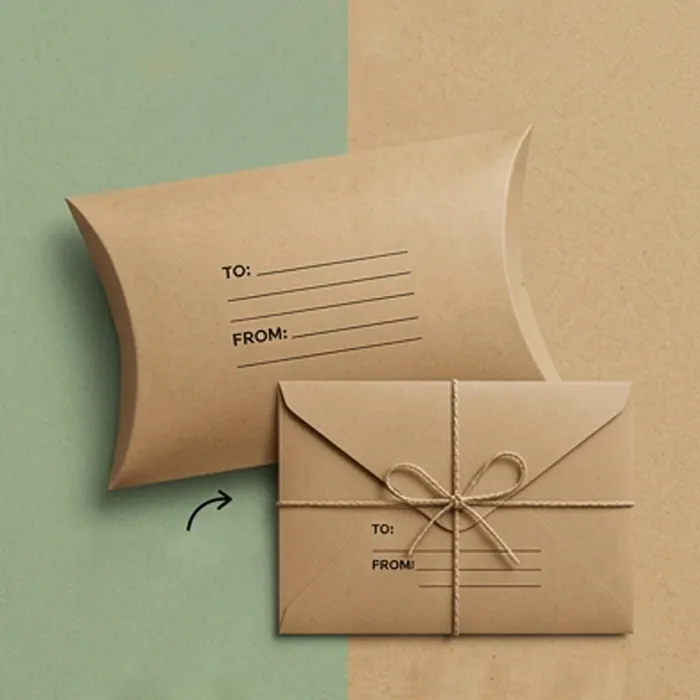
Pillow Mailers and Envelopes
Pillow packs specified for the post: address panel, secure closure, sized to rate.
View options
Large Pillow Boxes
Scaled up for apparel and gift sets, with the board weight to stop it bowing.
View options
Cardboard Pillow Boxes
Coated paperboard with a white printing face — the stock for full-color artwork.
View options
Candle Pillow Boxes
Board specified for the weight, with the safety copy planned onto the panel.
View optionsNext step
Ready to specify corrugated pillow boxes?
Send the product, the quantity and the date you need it on a shelf. We come back with a written quote, a specification and an honest view of anything in the brief that will not work.